The material

Perlite: volcanic rock, millions of years old, now in every building block.

Perlite is not a synthetic product and not an invention. It is a volcanic mineral with a combination of properties not found together in conventional building materials: completely non-combustible (A1), exceptionally insulating and 100% recyclable. This material has been formed into one of the few interlocking building systems with REI 240+M fire classification, CE certification under EN 771-3 and seismic assessment: System3E.

Sheet 01The materialGeology

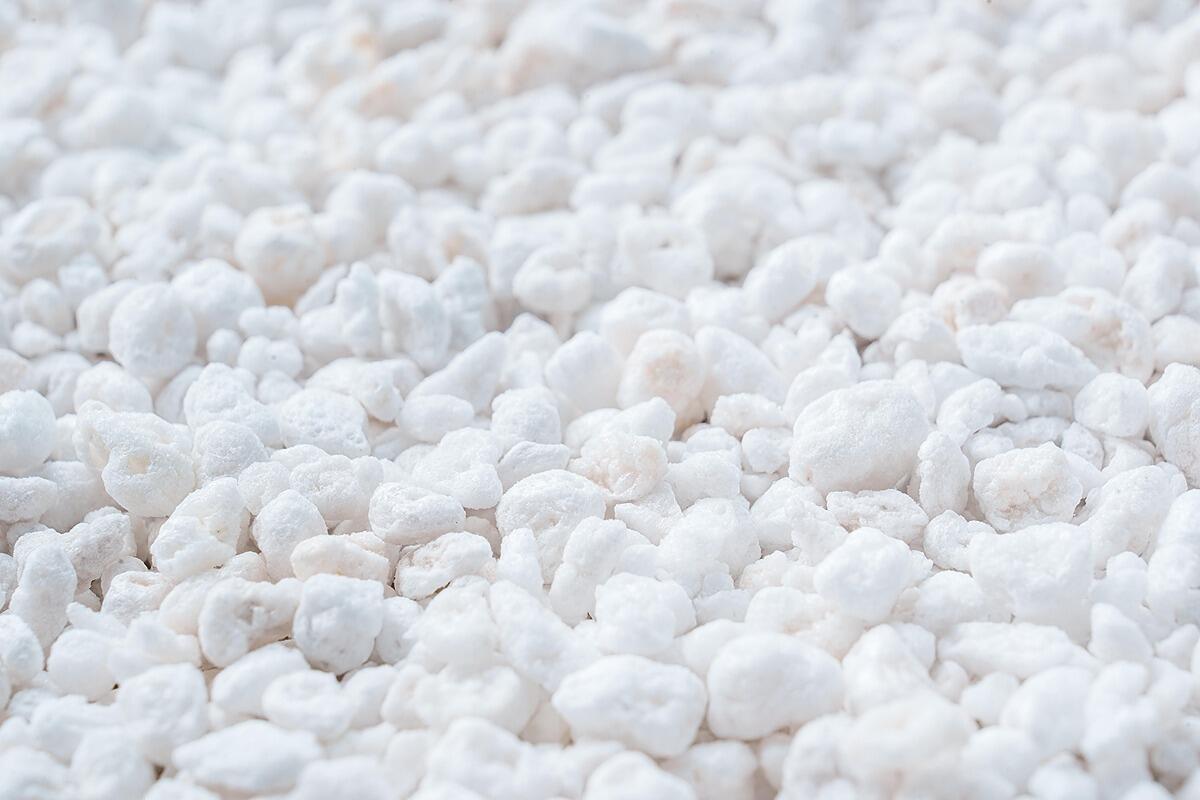
Expanded perlite granulate: the white, porous volcanic mineral
Lava in water: the geological process that converts obsidian into perlite

What is perlite?

Perlite is an amorphous volcanic silicate rock. It forms when obsidian, the glassy igneous rock created by the rapid cooling of lava, comes into contact with groundwater or surface water over millions of years. This prolonged hydration causes the rock to absorb a water content of 2 to 5 percent.

That water is not free water; it is chemically bound in the glass structure of the rock. This bound water is precisely what makes perlite so remarkable: when heated, it vaporises explosively and the material expands to up to twenty times its original volume. The result is an ultra-light, white and porous granulate with properties found nowhere else in nature in such combination.

The world's largest perlite reserves are in Greece (island of Milos), Turkey, the United States, China and Iceland. Perlite is one of the most available and affordable natural raw materials in the world.

Want to know whether perlite suits your climate zone?

Put your project to us

Reply within 1 business day

Sheet 02From rock to block5 steps

From volcanic rock to building block.

Five steps from raw rock to one of the strongest tested interlocking building blocks in Europe.

01

Extraction

Raw perlite is extracted from open-cast mines. At this point the rock has a grey-brown colour and a density of approximately 1,000 kg/m³, comparable to ordinary stone. After extraction it is coarsely milled to the desired particle size, depending on the intended application.

02

Expansion by heating

This is the transformation step. The milled perlite granulate is exposed to a temperature of 850 to 900°C in an expansion furnace. The chemically bound water in the rock vaporises explosively. The glassy mass becomes fluid and inflates itself from the inside, exactly like popcorn. Within seconds the material expands by a factor of 7 to 20.

The end result is a white, ultra-light granulate with a density of only 30 to 150 kg/m³. For comparison: concrete weighs 2,400 kg/m³.

03

Classification and purification

After expansion the expanded perlite is sieved and classified by particle size. Fine fractions go to the agricultural sector (substrate, soil conditioner) and industry (filter medium, refractory material). The construction fraction, coarser and stronger, proceeds to the next step.

04

Processing into blocks

The construction fraction of expanded perlite is processed into the interlocking blocks of System3E in a patented production process. No cement, no synthetic resin and no adhesive is used. The perlite is compressed and stabilised with a mineral bond that provides structural strength without compromising the thermal or fire performance properties.

System3E T-connections and corner connections: technical stacking plan

Every T-connection, corner and wall intersection has a fixed documented stacking sequence that eliminates thermal bridges.

05

Quality control and certification

Every production batch is tested for compressive strength, fire behaviour, thermal conductivity, water absorption and dimensional accuracy. Production takes place fully automated at the factory in Radomsko, Poland (8,100 m², 90% automated). Every block is CE-certified and complies with the European standard EN 771-3.

Want to know what delivery times look like for your volume?

Ask about lead times

Reply within 1 business day

Sheet 03PropertiesWhy perlite

The properties that conventional building materials cannot match.

Perlite combines properties that never occur simultaneously in conventional materials. Each property is a direct consequence of the mineralogical structure of the material, not of chemical additives.

>1,000°C

Completely non-combustible

Perlite is an inorganic silicate mineral. It contains no carbon, no polymers and no combustible components. The material melts only above 1,000°C and produces no toxic gases or smoke in a fire. Fire class A1 in accordance with EN 13501-1: the highest possible classification.

0.198

Exceptional insulation value

A single-leaf System3E wall of 352 mm achieves a U-value of 0.198 W/m²K, without extra insulation layers, without EPS, without plasterboard. For comparison: a conventional cavity wall of 35 cm concrete with 10 cm EPS insulation achieves a U-value of approximately 0.25 W/m²K. Perlite performs better in a single layer.

Rw 45 dB

Superior sound insulation

The porous cellular structure of expanded perlite absorbs sound rather than reflecting it. A single-leaf System3E wall achieves Rw = 45 dB. Conventional brickwork of 21 cm achieves Rw ≈ 47 dB, but is three times heavier and requires additional insulation for comparable thermal performance.

2/3

Lower CO₂ footprint

The production of perlite blocks emits two thirds less CO₂ than the production of equivalent concrete blocks. Perlite itself is a mineral processed without chemical reactions or high-energy synthesis. After the building's service life the material is fully recyclable and can be returned to the soil as a conditioner.

Low

Extremely low water absorption

Expanded perlite has extremely low water absorption. The closed cellular structure of the block strongly limits capillary rise, reducing the risk of mould and moisture problems. This makes perlite blocks particularly suited to humid tropical climates, maritime climates and areas with heavy rainfall.

Faster construction

Because the blocks are interlocking and dry-stacked, no cement, water or curing time is needed. The exterior walls of a 100 m² home stand within 24 hours, in one day (source: system3e.com). Less specialisation required, less equipment, less waste on site.

Up to 80%

Less construction waste

Because no mortar, cement, adhesive or additional insulation layers are needed, the amount of construction waste per home is up to 80 percent lower than in conventional construction. This reduces logistics costs, shortens the construction period and structurally reduces the environmental impact of the construction process. Less waste also means fewer containers, lower disposal costs and a cleaner, safer construction site.

0 VOC

No toxic substances

Perlite is chemically inert. It does not react with acids, bases or organic substances and does not emit volatile organic compounds (VOC). There is no off-gassing, no microplastics and no asbestos-like fibre. The material is completely safe during production, throughout occupancy and after demolition.

Dimensionally stable

Perlite does not shrink, expand or deform with temperature changes. This makes the material particularly suited to tropical climates, where thermal expansion of conventional materials leads to cracks, gaps and leakage risks. The blocks remain dimensionally accurate throughout the full service life of the building.
Sheet 04ComparisonSources appended

Perlite versus conventional building materials.

Property System3E perlite Concrete Brick Timber frame
Fire class A1 A1 A1 D–F
U-value (single leaf) 0.198 W/m²K >3.0 W/m²K >1.5 W/m²K Requires insulation
Additional insulation needed No Yes Yes Yes
Build speed (wall) 100 m²/day ≈30 m²/day ≈10 m²/day ≈50 m²/day
Water absorption Extremely low Low Moderate High
CO₂ production 2/3 lower High High Moderate
Recyclable 100% Limited Limited Partial
Mortar / cement needed No Yes Yes No

Source: System3E product documentation and independent test reports, see the certificates below.

Want this comparison made for your own reference project?

Ask for a comparison

Reply within 1 business day

Sheet 05CertificationDocuments auditable

Every performance figure is independently verified.

System3E is one of the few perlite block systems to have obtained all of the independent certificates and test results listed below. No marketing claims, only documented proof, the kind of documentation that supports a compliance review under frameworks as different as the Dutch Woningwet, Spain’s CTE and Portugal’s building code.

European standard

CE marking + EN 771-3

Declaration of conformity under the EU Construction Products Regulation (CPR). EN 771-3 is the European standard for masonry products from aggregate materials. Mandatory for every building product placed on the market in the EU.

Polish Building Research Institute

ITB assessment

The Instytut Techniki Budowlanej (ITB) is Poland's officially recognised building research institute. System3E is CE-certified and complies with the European product standard EN 771-3 for masonry units.

Fire resistance

REI 240 + M

Achieved in an accredited laboratory in accordance with EN 1365-1. REI 240 means the wall withstands 4 hours of fire without collapse (R), maintains its integrity (E) and insulating function (I). The +M designation confirms that the wall passes a 200 kg impact test after the fire test: mechanical integrity after four hours of fire.

Environmental performance

Declaration of Performance (DoP)

The DoP is a mandatory document under the EU CPR that records all performance declarations: thermal resistance, fire class, compressive strength, water absorption and durability. The DoP of System3E is publicly available and auditable.

Thermal performance

U-value 0.198 W/m²K

Measured in accordance with EN ISO 6946 (building components and elements: thermal resistance and thermal transmittance). The U-value of 0.198 W/m²K is achieved with a single-leaf wall of 352 mm, without any form of additional insulation.

Acoustic performance

Rw = 45 dB

Measured in accordance with EN ISO 10140 (laboratory measurements of sound insulation of building elements). Rw = 45 dB is measured for a single-leaf wall of 352 mm. For party walls with higher acoustic requirements the wall build-up is dimensioned to the project specification.

Material fire class

Euroclass A1 in accordance with EN 13501-1

Euroclass A1 is the highest fire classification for building materials and means the material is non-combustible, makes no contribution to a fire and releases no toxic gases when heated. Required for most public buildings, schools, healthcare buildings and social housing in Europe.

Need documentation your own engineer can assess?

Request the full dossier

Reply within 1 business day

RecordPerlite key figures

A1
Highest fire class, no contribution to fire
0.198
U-value W/m²K, single-leaf wall
100%
Recyclable volcanic mineral
REI 240
4 hours fire + 200 kg impact test
FAQ

Frequently asked questions

What exactly is perlite?

Perlite is an amorphous volcanic silicate rock. When heated it expands up to twenty times its original volume, which produces an ultralight, white, porous granulate. The largest deposits are in Greece, Turkey, the United States, China and Iceland, and perlite is one of the most widely available natural materials in the world.

How does perlite compare with concrete and brick?

A 35 cm single-leaf System3E perlite wall reaches a thermal transmittance of 0.198 W/m²K without additional insulation, where concrete stays above 3.0 and brick above 1.5 and both still need insulation. Wall construction runs at roughly 100 m² per day against about 30 for concrete and 10 for brick.

Is perlite a sustainable choice?

Perlite is a natural volcanic mineral, not a synthetic product. The blocks are 100% recyclable and produce up to two thirds less CO2 than traditional construction. Because they are stacked dry, there is no construction waste from mortar, no microplastics and no water consumption on site.

Building with perlite

Want to know what this means for your project?

We translate the properties of perlite into a fully developed building package, including construction drawings, foundation drawings and installations.

Start a conversation